Are Dental Chews Worth It? What the Evidence Actually Says
We may earn a commission from links on this page, at no extra cost to you. How this works.


- The word "dental" on a bag guarantees nothing — the VOHC Seal of Acceptance is the one credential actually backed by measured plaque and tartar reduction data, and it's worth checking for by name.
- A dental chew only works if your dog chews it, not gulps it — a determined swallower gets none of the mechanical scraping benefit and all of the calories.
- Dental chews are a supplement to brushing and vet cleanings, not a replacement for either — and they count fully toward the ~10% treat-calorie budget.
"Dental" is one of the most overused words in the treat aisle, and it costs a brand nothing to print. So the honest question isn't "does this treat say dental" — it's whether there's any real evidence behind it, and whether that evidence applies to the way your dog actually chews.
Short answer: some dental chews genuinely work, and the way to tell them apart from the rest is a specific credential most owners have never heard of — the VOHC Seal. Here's what it verifies, what it doesn't, and how a daily dental chew fits (or doesn't) into a treat-motivated household like mine.
The credential that actually means something: the VOHC Seal
The Veterinary Oral Health Council is an independent body that reviews clinical trial data submitted by manufacturers and awards its seal only to products that demonstrate a measurable reduction in plaque and/or tartar against a control group. It covers chews, treats, water additives, diets, and toothpaste — not just the chew category.
That's a meaningfully higher bar than anything else printed on a treat bag. Compare it to the words surrounding it on the same shelf: "dental," "clean teeth," "fresh breath," and "tartar control" are not regulated claims. Any brand can print them regardless of whether a single study backs them up — the same problem we ran into with "natural" and "premium" in our guide to reading a dog treat label. The VOHC Seal is the exception, not the rule, and it's the one thing on a dental-chew bag actually worth checking for by name.
What the evidence actually shows
For products that carry the seal, published trial results generally show plaque and/or tartar reductions somewhere in the range of roughly 10–40%, depending on the specific product, the mechanism (some target plaque, some tartar, some both), and how closely the trial matches real-world use. That's a real, measured effect on two of the visible precursors to periodontal disease — not a marketing number pulled from nowhere.
It's also not a small effect made to sound big. Two honest caveats sit right next to that number:
- It's a reduction, not a prevention. A dog can still develop periodontal disease with a dental chew in daily rotation — the chew lowers the odds and the buildup rate, it doesn't zero them out.
- The trial conditions assume the chew is actually chewed. Reduction percentages come from controlled studies where dogs used the product as intended. A dog who swallows the chew in three bites is not replicating those study conditions, and neither is a dog given the wrong size for their jaw.
The part most owners get wrong: how the chew is used
A dental chew does two things at once — a mechanical scrape from the texture as teeth work through it, and in some products, a chemical or enzymatic component released as it's chewed. Both mechanisms need sustained chewing time to do anything. A chew that's gone in under a minute delivers almost none of either.
This is where a lot of "does dental chews work" skepticism online actually comes from a sizing or matching problem, not a category problem:
- Too small for the dog. A chew sized for a 15 lb dog disappears in seconds down a 60 lb dog's throat — no scrape time, all calories.
- Too soft or fast-dissolving. Some "dental" treats are closer to a flavored soft chew than a working chew — pleasant, not functional.
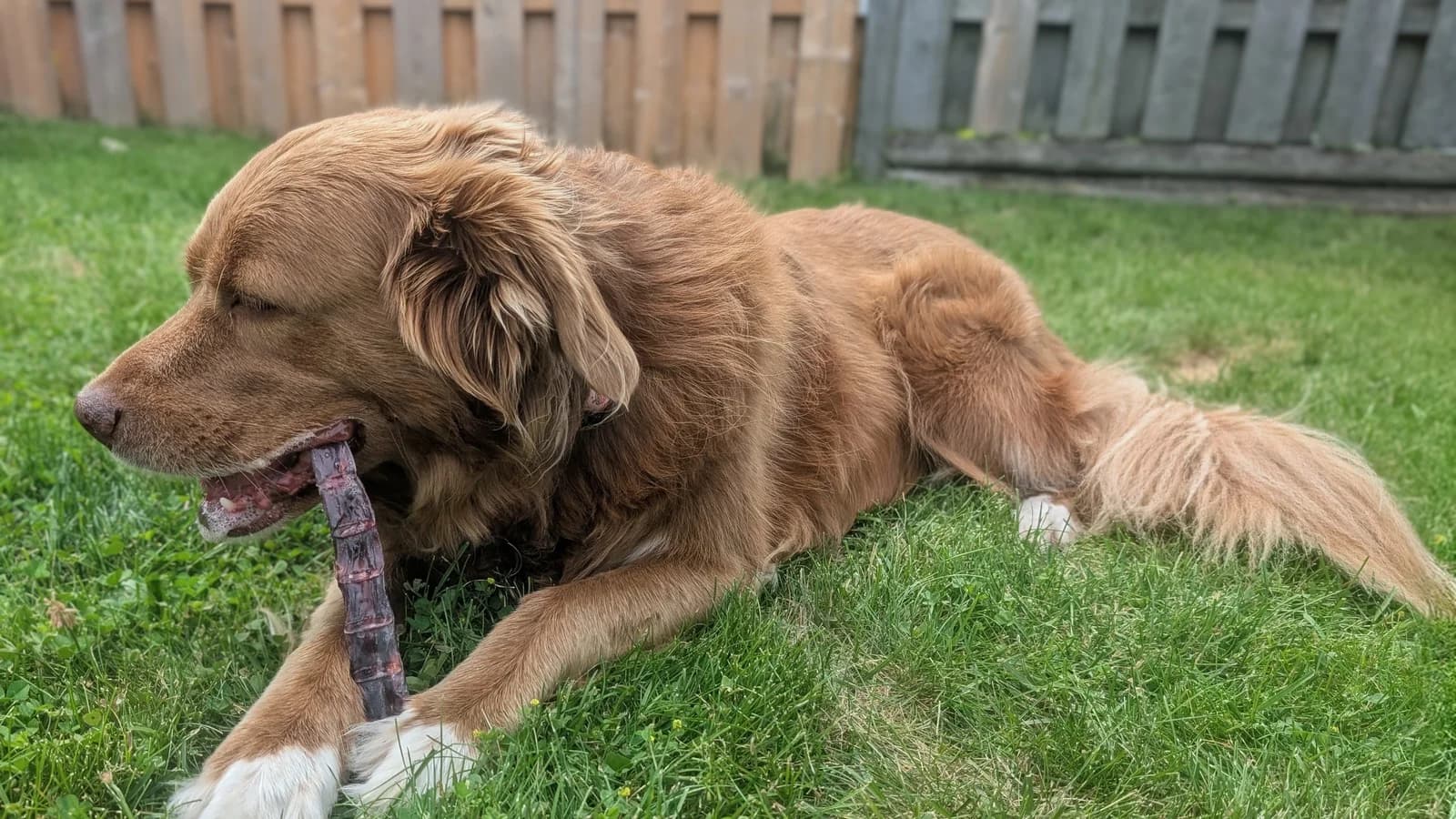
- Gulpers. Some dogs, ours included on occasion, treat any chew as a race. If that's your dog, size up aggressively and supervise, the same rules we cover in are bully sticks safe for dogs — the sizing logic is identical even though a bully stick itself isn't a VOHC-tested dental product.
What a dental chew can't do
However good the trial data, a dental chew is not a substitute for the two things that actually control periodontal disease long-term:
- Daily brushing. Still the single most effective thing an owner can do at home — mechanical removal every day beats a chew a few times a week. If brushing isn't happening in your house (it mostly isn't in mine, if I'm honest), a dental chew is a reasonable partial substitute, not an equivalent one.
- Professional cleanings. Once tartar has hardened at or below the gumline, no chew reaches it. A vet dental exam catches problems a chew can mask by keeping visible tartar down while disease progresses underneath.
The calorie catch
A dental chew is still a chew, and chews are calorie-dense per piece — the same math we walk through in how many treats per day. Depending on size, a dental chew can run anywhere from around 30 to 70-plus calories, which is a real chunk of the ~10% of daily calories treats should stay under, especially for a small or senior dog.
If a dental chew is going into the daily rotation rather than an occasional one, it needs to be planned into the budget the same way a daily bully stick would be — not stacked on top of training treats and dinner as if it doesn't count.
1. VOHC-Accepted Dental Chews
The one dental-chew credential actually backed by measured plaque and tartar data.
Pros
- VOHC Seal requires real plaque/tartar-reduction trial data, unlike "dental" on a label
- Textured/ridged designs work mechanically as the dog chews, not just chemically
- Sizes for most jaw sizes, from toy breeds to large chewers
Cons
- Calorie-dense like any chew — count it toward the 10% rule
- Only works if your dog actually chews it (not gulps it)
- Supplements brushing — does not replace it
Who benefits most
Dental chews aren't equally valuable for every dog:
- Small and toy breeds are disproportionately prone to crowded teeth and faster tartar buildup — a daily VOHC-accepted chew, sized correctly, is one of the better returns in this category.
- Senior dogs often have years of buildup already and may chew less enthusiastically — see our notes on treat texture and aging noses in best treats for senior dogs. A softer VOHC-accepted option can still fit, as long as it isn't so soft it disappears in seconds.
- Dogs who won't tolerate brushing get more real value from a consistent dental chew than a dog whose owner already brushes daily — for the second dog, a chew is a nice-to-have on top of the thing that already works.
How we handle it at home
Roxy and Mittens are both eight-plus, and tartar management matters more now than it did at two. We don't brush daily — I'll say that plainly rather than pretend otherwise — so a VOHC-accepted chew earns a regular spot in the rotation specifically because it's one of the few dental products with real data behind the claim, not just a nice-smelling bag. It goes into the calorie count the same way a bully stick does, and on chew days, dinner gets sized down slightly to match — the same habit from our 10% rule guide.
It isn't a replacement for their annual dental checks. It's the thing that happens between them.
The bottom line
Dental chews are worth it when the product actually carries the VOHC Seal, is sized so your dog spends real minutes working through it, and gets counted honestly against the daily treat budget. They're not worth it as a brushing replacement, a cure for existing dental disease, or a soft treat that happens to say "dental" on the front. Check for the seal by name, match the size to your dog's actual chewing style, and treat the results as maintenance — not a substitute for the vet visit where real problems actually get caught.
I'm a dog owner, not a veterinarian. If your dog has existing dental disease, a health condition, or you're not sure what's normal, run it past your vet before changing their routine.
Frequently asked
- What does the VOHC Seal on a dental chew actually mean?
- The Veterinary Oral Health Council reviews clinical trial data submitted by manufacturers and awards its seal only to products that meet a defined threshold of plaque and/or tartar reduction, tested against a control group. It is not a marketing badge a brand can print for free — it is the closest thing this category has to real evidence, and it is worth looking for by name rather than trusting the word "dental" on the front of the bag.
- Do dental chews replace brushing or professional cleanings?
- No. Even VOHC-accepted chews are studied and marketed as an addition to a dental care routine, not a substitute for it. Daily brushing remains the single most effective thing an owner can do at home, and a professional cleaning under anesthesia is still the only way to address disease below the gumline. A dental chew is a reasonable supplement for a dog who won't tolerate brushing, not a way to skip the vet.
- How much do dental chews actually reduce plaque and tartar?
- For VOHC-accepted products, published trial results typically show plaque and tartar reductions in the range of roughly 10–40%, depending on the specific product and whether it targets plaque, tartar, or both. That is a real, measurable effect — but it is a reduction, not a prevention or a cure, and it depends on the chew being used as directed, consistently.
- Do dental chews count toward the 10% treat-calorie rule?
- Yes, fully — a dental chew is a treat first and a dental product second. Many dental chews run 30–70+ calories depending on size, which can be a meaningful share of a small or senior dog's daily treat budget. See our breakdown of the 10% rule for how to fit a daily dental chew into the math instead of stacking it on top of everything else.
- Are the soft "dental" sticks that dissolve quickly still worth it?
- Less so. The mechanical benefit of a dental chew comes from sustained contact between the chew's texture and the tooth surface — a stick that softens and disappears in under a minute gives almost no scraping time. If a product doesn't carry the VOHC Seal, a soft, fast-dissolving texture is one of the clearer signs it was designed to be eaten quickly, not chewed thoroughly.
← Back to the full limited ingredient guide
Marc
I'm Marc, the dog owner behind The Clean Hound. I read the ingredient panel on my own food — avoiding processed junk and labels full of things I can't pronounce — so I feed my two dogs, Roxy and Mittens, the same way: a raw diet and only single-ingredient or human-grade treats. Everything I recommend is a treat I'd actually give them. I'm not a veterinarian, so my content is general information, not medical advice.
How we review: I judge every treat on ingredient transparency, allergen risk, protein novelty, sourcing, processing, and value — the same label-reading standard I use for my own food. I favor short, single-protein and limited-ingredient recipes, cross-check the marketing against the actual panel, and lean on reputable veterinary-nutrition guidance.