How Many Treats Per Day? The 10% Rule Explained
We may earn a commission from links on this page, at no extra cost to you. How this works.


- The "10% rule" is about calories, not pieces — vets recommend treats make up no more than about 10% of a dog's total daily calorie intake, with the other 90% coming from a complete, balanced diet.
- A single dense chew (bully stick, dental chew) can eat the whole daily budget by itself — piece-counting hides how fast calories add up.
- On heavy-treat days, the fix isn't skipping treats, it's trimming dinner to match — something raw and fresh feeders can do more precisely than kibble feeders scooping a fixed cup.
Every dog owner eventually asks some version of the same question: "is this too many treats?" The honest answer almost never depends on how many pieces went in the bowl — it depends on calories, and calories are a lot easier to blow past than piece-counting makes it feel.
The rule vets reach for is simple to say and slightly fiddly to apply: treats should stay under about 10% of a dog's total daily calories. Here's what that actually means in practice, how to do the math for your own dog, and how we handle it in a raw-fed household where "just add a cup of kibble" isn't an option.
What the 10% rule actually says
The number comes from general veterinary nutrition guidance — including WSAVA's global nutrition guidelines — which frames treats, table scraps, and training rewards as a share of total daily calorie intake, capped at roughly a tenth. The other ~90% is supposed to come from a diet that's complete and balanced on its own.
The reasoning is straightforward: a complete diet is formulated so the vitamins, minerals, and macros land in the right ratios for the calories it provides. Treats are almost never formulated that way — even a "healthy" single-ingredient treat is still an unbalanced add-on. Let treats creep past 10% and you're not just adding calories, you're diluting how much of the day's nutrition comes from the food that was actually built to deliver it.
Why piece-counting fools people
"Three treats a day" sounds like a rule. It isn't one, because a treat isn't a unit of calories — it's a unit of size. A pea-sized training treat and a rawhide-thick bully stick are both "a treat," and they are not remotely the same math.
This is where the rule quietly breaks in most households:
- Training sessions add up fast. A dozen pea-sized treats in a 10-minute session feels like nothing, but a dozen of even a modest 3-calorie treat is 36 calories before dinner's been touched.
- Chews are calorie-dense and slow to register as "eating." A dog gnawing a bully stick for 20 minutes doesn't look like a dog eating a meal, but the calories are real and often substantial — see below.
- "A handful" scales with the bag, not the dog. A handful of small kibble-style treats for a 70 lb dog and the same handful for a 12 lb dog are the same calorie hit, applied to very different daily budgets.
Doing the actual math
- Find your dog's daily calorie need. Ask your vet for this number — it accounts for weight, age, and activity better than any online calculator. As a rough estimate for a healthy adult dog at a stable weight, resting energy requirement scales with body weight, and most moderately active dogs land somewhat above that baseline.
- Multiply by 0.10. That's your daily treat ceiling in calories.
- Check the treat's actual calorie count, not its size. Freeze-dried treats and jerky-style chews list calories per piece or per gram on the bag — use it.
- Track chews separately from training treats, since chews are usually the bigger single hit.
| Dog's approx. weight | Rough daily calories | ~10% treat budget |
|---|---|---|
| 10 lb | ~300–400 kcal | ~30–40 kcal |
| 30 lb | ~700–800 kcal | ~70–80 kcal |
| 50 lb | ~1,000–1,200 kcal | ~100–120 kcal |
| 80 lb | ~1,400–1,700 kcal | ~140–170 kcal |
These are rough planning ranges, not prescriptions — activity level, spay/neuter status, and metabolism shift the real number meaningfully. Use your vet's figure for anything that matters, like managing a dog who's already overweight.
Where the budget actually goes: chews vs. training treats
The two treat categories behave completely differently against a 10% ceiling.
Long-lasting chews — bully sticks, dental chews, antlers — are calorie-dense per piece because there's simply more product. A single bully stick can run anywhere from roughly 45 calories for a thin, short one to well over 100 for a thick, long one. For a 30 lb dog with an ~75 calorie budget, one substantial chew can be the whole day's allowance.
1. Best Bully Sticks Natural Chews
Single-ingredient natural chews for longer-lasting enrichment.
Pros
- Single-ingredient natural chews
- Longer-lasting than soft treats
- Range of sizes for different chewers
Cons
- Not calorie-free — count toward the 10% rule
- Supervise heavy chewers
Training and reward treats are usually small per piece, which is exactly why they get over-fed — a long training session or a day of "just being extra good" can rack up 20–30 small pieces without anyone counting. The fix isn't avoiding training treats, it's sizing them down and, ideally, picking something you can break smaller. Crumbled freeze-dried protein solves this cleanly since there's nothing to portion out except with your fingers.
2. Single-Ingredient Freeze-Dried Treats
One ingredient, nothing else — the simplest possible label.
Pros
- Literally one ingredient (e.g. pure liver or fish)
- Easy to match to an elimination diet
- Broad availability and formats
Cons
- Quality varies by brand — check sourcing
- Some are rich; use small pieces
How we actually run this at home
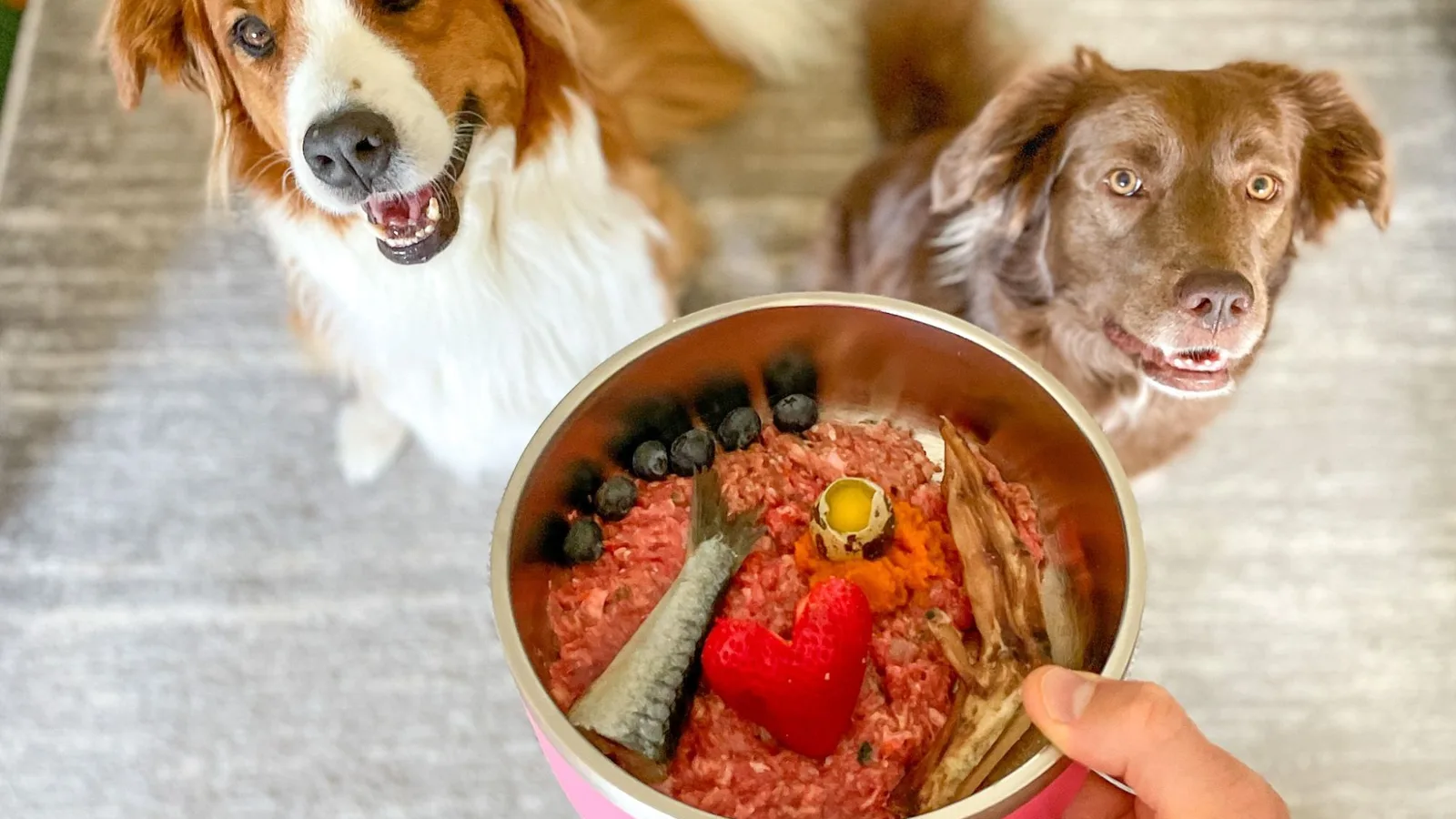
We raw-feed both Roxy and Mittens, which changes the mechanics of the 10% rule in a way kibble feeding doesn't. A kibble feeder scooping a fixed daily cup has to consciously subtract a portion to make room for treat calories. With raw, dinner is already weighed and portioned per meal, so trimming it down on a heavy-treat day is just as easy as measuring out slightly less.
In practice: on a day either dog gets a full bully stick, or we've run a longer training session with a pocket full of freeze-dried liver, dinner that night gets portioned a bit smaller — not skipped, just brought down to keep the day's total where it should be. It's the same logic as adjusting your own dinner after a heavier lunch, and it's the most reliable way we've found to keep two treat-motivated dogs at a stable weight without ever telling them "no" at training time.
The mechanism works the same on kibble — it just takes an extra step of converting the treat calories back into "how much less kibble," since you can't shave a fraction of a scoop as precisely as you can adjust a raw portion or a home-cooked meal by weight.
The takeaway
Ten percent is a calorie ceiling, not a piece count — and the fastest way to accidentally blow past it is trusting your eyes on treat size instead of checking what's actually on the bag. Track chews and training treats as the two very different calorie categories they are, and when a heavy-treat day happens, trim the next meal instead of the treats. For more on keeping the rest of the label honest while you're at it, our limited-ingredient guide covers what to look for once the calorie math is sorted.
Frequently asked
- Where does the "10% rule" for dog treats actually come from?
- It traces back to general veterinary nutrition guidance — including WSAVA's global nutrition guidelines — that treats and extras should stay under roughly 10% of a dog's total daily calories, so the complete-and-balanced main diet still does the nutritional heavy lifting. It's a widely-used rule of thumb, not a single hard regulatory limit, so treat it as a ceiling to plan around rather than a number to hit exactly.
- Does the 10% rule mean 10% of my dog's food by weight?
- No — calories, not weight or pieces. A teaspoon of peanut butter and a large bully stick can be wildly different weights but comparable calorie hits. Piece-counting or "a handful" measuring is exactly how the rule gets broken without anyone noticing.
- How many calories should my dog get from treats per day?
- Take your dog's total daily calorie need (your vet can give you this, or estimate from their target weight) and multiply by 0.10. A 30 lb dog eating roughly 700–800 calories a day has a treat budget around 70–80 calories — smaller than most owners assume once a chew or two is in the mix.
- Do chews like bully sticks count toward the 10% rule?
- Yes, fully. Long-lasting chews are still calories, and because dogs work on them for a while it's easy to forget they're "eating." A single stick can run anywhere from roughly 45 to over 100 calories depending on size — sometimes the whole daily treat budget in one chew.
- What if I go over the 10% rule on a big training or chew day?
- Trim the next meal to compensate, the same way you would after a calorie-heavy dinner yourself. We do this at home: on days Roxy or Mittens gets a full bully stick or a long training session, dinner gets portioned a bit smaller to bring the day back in balance. The goal is the daily total, not perfection meal by meal.
← Back to the full limited ingredient guide
Marc
I'm Marc, the dog owner behind The Clean Hound. I read the ingredient panel on my own food — avoiding processed junk and labels full of things I can't pronounce — so I feed my two dogs, Roxy and Mittens, the same way: a raw diet and only single-ingredient or human-grade treats. Everything I recommend is a treat I'd actually give them. I'm not a veterinarian, so my content is general information, not medical advice.
How we review: I judge every treat on ingredient transparency, allergen risk, protein novelty, sourcing, processing, and value — the same label-reading standard I use for my own food. I favor short, single-protein and limited-ingredient recipes, cross-check the marketing against the actual panel, and lean on reputable veterinary-nutrition guidance.